
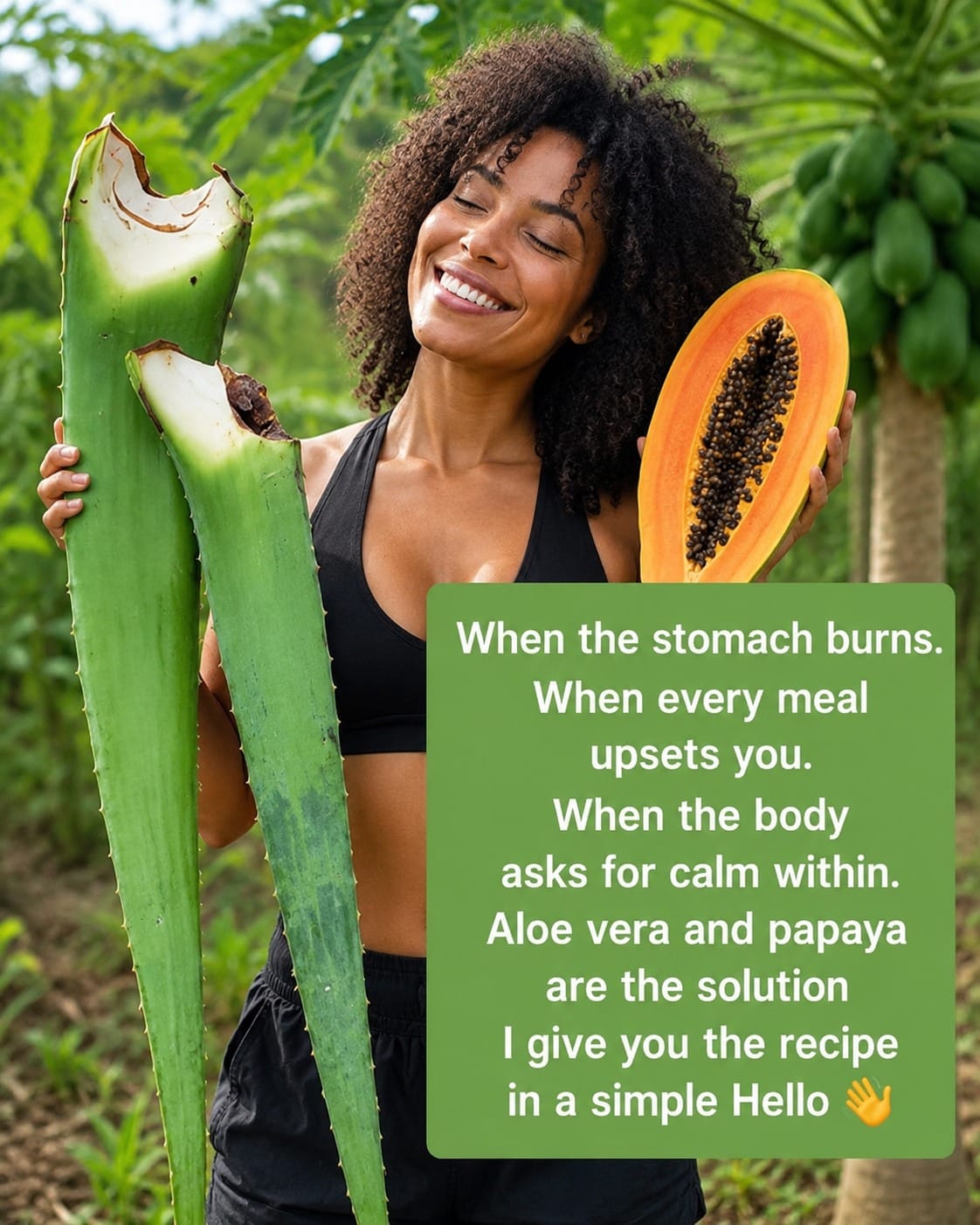
That burning knot under your ribs. The sour climb into your throat. The way a meal turns from comfort into a live wire.
Papaya and aloe vera attack that fire from two different angles. Papaya brings papain, a protein-cutting enzyme that slices heavy food into smaller pieces before it can sit there like wet cement. Aloe vera coats the irritated lining like a cool film over a raw scrape, and the first swallow can feel almost shocking — smooth, slippery, faintly green, like your insides just got rinsed.
That is why people with gastritis, acid reflux, bloating, and that ugly “my stomach hates everything” feeling keep reaching for this pairing. Not because the body is confused. Because the stomach is screaming for relief and most people keep feeding it the same rough, acid-stoking mess.
And here’s the part that makes people angry: the burn is often treated like a random nuisance, when it’s usually a system under pressure. Acid rises, the lining gets scraped, digestion slows, and every meal feels like it lands on a bruise. There’s a reason the pain shows up after the first few bites — and it starts with what happens before food even leaves the stomach.
There’s a deeper mechanism here, and it’s not the fluffy wellness story most people hear…
The Digestive Split
Think of your stomach like a pressure cooker with a damaged seal. When the seal is intact, heat and acid stay where they belong. When it’s irritated, every burp, every bend, every late-night meal becomes a small explosion.
That’s where papaya earns its reputation. Papain works like a tiny set of scissors in a crowded kitchen, cutting protein into easier pieces so your stomach doesn’t have to grind and strain as hard. Less strain means less trapped heaviness, less fermentation, less of that brick-in-the-belly feeling after eating.
Aloe vera plays the opposite role. It doesn’t cut — it coats. It lays down a slick barrier over irritated tissue, the way a fresh layer of water cools skin after too much sun. The lining stops feeling sandpapered every time acid moves.
That’s the real trick: one ingredient reduces the workload, the other reduces the damage.
Most people only chase symptoms after the burn has already started. They sip water, pop antacids, lie down, then wonder why the same meal keeps detonating their chest. But the body doesn’t forget a bad pattern — it repeats it, meal after meal, until something changes.
And the underdog truth? Wall Street doesn’t build empires around a fruit that grows on a backyard tree or a plant people snap open for the gel inside. That doesn’t mean the biology is weak. It means the profit machine is.
But papaya and aloe are not doing the same job, and that difference matters more than people realize…
When the Burn Starts in the Wrong Place
For the person who feels the burn in the chest first, the problem is often reflux pressure. Acid is climbing where it should never go, like sewer water backing up into the clean sink line. That hot sting after lying down? That sour taste in the mouth? That’s the system pushing upward instead of moving forward.
Aloe vera can help blunt that internal abrasion by laying a protective film over the irritated path. It’s like putting a slick barrier between raw metal and friction. The throat stops feeling scraped, and that ugly aftertaste loses some of its bite.
Then there’s the person whose stomach feels swollen, slow, and stubborn after almost every meal. Papaya steps in here like a demolition crew for food chunks that refuse to break down. When proteins sit too long, they turn the gut into a fermentation chamber — gas builds, pressure rises, and the belly feels tight enough to unbutton.
After a few days of consistent use, the first thing people notice is not magic. It’s less backlash after eating. Less heaviness. Less of that trapped, acidic churn that makes you dread the next plate.
And that shift can feel almost unfairly simple, which is exactly why so many people miss it…
The Two-Front Relief
For women juggling stress, meals on the run, and a stomach that reacts like it has a grudge, the relief often shows up as quiet space. The chest doesn’t flare as hard after dinner. The belly doesn’t feel like a balloon pulled too tight. You can sit upright without that acid clawing at the back of your throat.
For men who push through discomfort and call it “just indigestion,” the change is usually more physical than emotional. The bloat backs off. The heaviness loosens. The body stops sending that blunt, nagging signal that says, something is sitting in here too long.
That’s because the combination attacks two bottlenecks at once: digestion speed and tissue irritation. Papaya helps move food through the system before it turns into sludge. Aloe helps calm the raw surface that keeps getting re-burned.
Picture a drain that’s half-clogged and a pipe that’s already scraped inside. Clearing the clog without protecting the pipe just causes more damage. Protecting the pipe without clearing the clog leaves pressure building. Together, they change the whole mess.
And once the pattern shifts, the body starts acting like it finally got the memo…
The Recipe Trap Most People Miss
The biggest wrench is not the ingredients. It’s the prep.
Use the wrong aloe and you turn relief into irritation. The yellow latex under the skin is the bitter, sticky layer that can hit the stomach like bleach on a cut — sharp smell, harsh taste, and a body that clenches instead of relaxes. That layer has to stay out.
Same with papaya. Overripe fruit, giant portions, or pairing it with a heavy greasy meal can drag the whole process backward. You don’t want a digestive rescue mission buried under fried food and sugar.
The win is in the clean pairing: pure aloe gel, ripe papaya, and a stomach that isn’t being hammered by the wrong meal at the same time.
And there’s one more detail people miss that changes everything…
Drink it at the wrong moment, and you can blunt the effect before it starts. Drink it with the wrong food, and you can turn a soothing blend into just another sweet glass sitting on top of a problem.
This is why some people swear by it and others shrug. The difference is often not the plant. It’s the timing, the inner gel, and the way the rest of the plate is built around it.
Get that wrong, and the burn stays. Get it right, and the stomach finally gets a chance to unclench…
This article is for informational purposes only and does not replace professional medical advice. Please consult your healthcare provider for personalized guidance.
That burning knot under your ribs. The sour climb into your throat. The way a meal turns from comfort into a live wire.
Papaya and aloe vera attack that fire from two different angles. Papaya brings papain, a protein-cutting enzyme that slices heavy food into smaller pieces before it can sit there like wet cement. Aloe vera coats the irritated lining like a cool film over a raw scrape, and the first swallow can feel almost shocking — smooth, slippery, faintly green, like your insides just got rinsed.
That is why people with gastritis, acid reflux, bloating, and that ugly “my stomach hates everything” feeling keep reaching for this pairing. Not because the body is confused. Because the stomach is screaming for relief and most people keep feeding it the same rough, acid-stoking mess.
And here’s the part that makes people angry: the burn is often treated like a random nuisance, when it’s usually a system under pressure. Acid rises, the lining gets scraped, digestion slows, and every meal feels like it lands on a bruise. There’s a reason the pain shows up after the first few bites — and it starts with what happens before food even leaves the stomach.
There’s a deeper mechanism here, and it’s not the fluffy wellness story most people hear…
The Digestive Split
Think of your stomach like a pressure cooker with a damaged seal. When the seal is intact, heat and acid stay where they belong. When it’s irritated, every burp, every bend, every late-night meal becomes a small explosion.
That’s where papaya earns its reputation. Papain works like a tiny set of scissors in a crowded kitchen, cutting protein into easier pieces so your stomach doesn’t have to grind and strain as hard. Less strain means less trapped heaviness, less fermentation, less of that brick-in-the-belly feeling after eating.
Aloe vera plays the opposite role. It doesn’t cut — it coats. It lays down a slick barrier over irritated tissue, the way a fresh layer of water cools skin after too much sun. The lining stops feeling sandpapered every time acid moves.
That’s the real trick: one ingredient reduces the workload, the other reduces the damage.
Most people only chase symptoms after the burn has already started. They sip water, pop antacids, lie down, then wonder why the same meal keeps detonating their chest. But the body doesn’t forget a bad pattern — it repeats it, meal after meal, until something changes.
And the underdog truth? Wall Street doesn’t build empires around a fruit that grows on a backyard tree or a plant people snap open for the gel inside. That doesn’t mean the biology is weak. It means the profit machine is.
But papaya and aloe are not doing the same job, and that difference matters more than people realize…
When the Burn Starts in the Wrong Place
For the person who feels the burn in the chest first, the problem is often reflux pressure. Acid is climbing where it should never go, like sewer water backing up into the clean sink line. That hot sting after lying down? That sour taste in the mouth? That’s the system pushing upward instead of moving forward.
Aloe vera can help blunt that internal abrasion by laying a protective film over the irritated path. It’s like putting a slick barrier between raw metal and friction. The throat stops feeling scraped, and that ugly aftertaste loses some of its bite.
Then there’s the person whose stomach feels swollen, slow, and stubborn after almost every meal. Papaya steps in here like a demolition crew for food chunks that refuse to break down. When proteins sit too long, they turn the gut into a fermentation chamber — gas builds, pressure rises, and the belly feels tight enough to unbutton.
After a few days of consistent use, the first thing people notice is not magic. It’s less backlash after eating. Less heaviness. Less of that trapped, acidic churn that makes you dread the next plate.
And that shift can feel almost unfairly simple, which is exactly why so many people miss it…
The Two-Front Relief
For women juggling stress, meals on the run, and a stomach that reacts like it has a grudge, the relief often shows up as quiet space. The chest doesn’t flare as hard after dinner. The belly doesn’t feel like a balloon pulled too tight. You can sit upright without that acid clawing at the back of your throat.
For men who push through discomfort and call it “just indigestion,” the change is usually more physical than emotional. The bloat backs off. The heaviness loosens. The body stops sending that blunt, nagging signal that says, something is sitting in here too long.
That’s because the combination attacks two bottlenecks at once: digestion speed and tissue irritation. Papaya helps move food through the system before it turns into sludge. Aloe helps calm the raw surface that keeps getting re-burned.
Picture a drain that’s half-clogged and a pipe that’s already scraped inside. Clearing the clog without protecting the pipe just causes more damage. Protecting the pipe without clearing the clog leaves pressure building. Together, they change the whole mess.
And once the pattern shifts, the body starts acting like it finally got the memo…
The Recipe Trap Most People Miss
The biggest wrench is not the ingredients. It’s the prep.
Use the wrong aloe and you turn relief into irritation. The yellow latex under the skin is the bitter, sticky layer that can hit the stomach like bleach on a cut — sharp smell, harsh taste, and a body that clenches instead of relaxes. That layer has to stay out.
Same with papaya. Overripe fruit, giant portions, or pairing it with a heavy greasy meal can drag the whole process backward. You don’t want a digestive rescue mission buried under fried food and sugar.
The win is in the clean pairing: pure aloe gel, ripe papaya, and a stomach that isn’t being hammered by the wrong meal at the same time.
And there’s one more detail people miss that changes everything…
Drink it at the wrong moment, and you can blunt the effect before it starts. Drink it with the wrong food, and you can turn a soothing blend into just another sweet glass sitting on top of a problem.
This is why some people swear by it and others shrug. The difference is often not the plant. It’s the timing, the inner gel, and the way the rest of the plate is built around it.
Get that wrong, and the burn stays. Get it right, and the stomach finally gets a chance to unclench…
This article is for informational purposes only and does not replace professional medical advice. Please consult your healthcare provider for personalized guidance.