
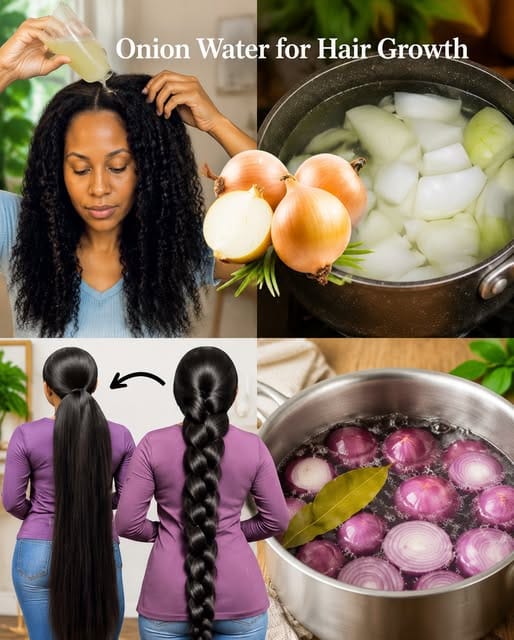
Onion is doing something most people never connect to hair growth: it floods the scalp with sulfur-rich raw biological fuel that hair follicles use to build stronger strands, reduce breakage, and push out the weak, wispy growth that keeps stalling at the same length. That sharp kitchen staple in the screenshot is not being sold as a beauty gimmick — it is being framed as a root-level reset for thinning hair, slow growth, and the kind of shedding that leaves your brush looking like a crime scene.
And that matters when your ponytail starts shrinking, your crown starts showing through under bathroom lighting, and every shower feels like a fresh insult. You wash, you condition, you promise yourself you’ll be gentler this time, then the drain fills up again and your confidence takes the hit before breakfast.
The real problem is not that your hair is “bad.” It is that the scalp environment has been starved, clogged, and underfed for so long that the follicles are acting like tired factory machines with no parts coming in.
That is where onion gets its edge. Not as magic. As a chemical signal that tells dormant tissue to stop drifting and start producing.
The scalp wake-up switch hidden in a kitchen staple
Think of your scalp like a row of tiny irrigation pumps buried under dry soil. When the lines are clogged and the ground is depleted, nothing above the surface looks alive for long.
Onion brings in sulfur compounds, molecular brooms, and fire-smothering compounds that help clear the mess around the follicle while feeding the keratin-building process hair depends on. The first thing people notice is not instant Rapunzel-length hair — it is that the scalp feels less irritated, less tight, less like a patch of land that has been abandoned.
The $100-billion wellness machine barely whispers about a vegetable that grows in a grocery bin and can’t be trademarked. That is the ugly truth. Wall Street does not build empires around something you can slice open on a cutting board.
So while the industry keeps selling glossy bottles and miracle promises, onion works on the boring, brutal reality underneath: follicles need raw material, circulation, and a cleaner environment before they can do their job.
Why thinning hair starts showing up first at the crown and hairline
When hair starts disappearing at the crown, it feels like the scalp is slowly opening a trapdoor under your confidence. The part widens. The ponytail thins. The front edges start looking see-through in sunlight and harsh bathroom mirrors.
That is what happens when the follicle is stuck in a weak production cycle. Onion acts like a maintenance crew arriving to a factory where the conveyor belt has slowed to a crawl and dust is choking the gears.
After a few days of consistency, the shift shows up in the feel of the scalp first. Less itch. Less buildup. Less of that heavy, greasy, tired sensation that makes the roots feel glued down.
Then the pattern gets clearer: strands stop snapping so easily, the brush stops collecting as much fallout, and the hair begins holding onto length instead of shedding it like dead grass in a dry wind.
That is why people chasing longer hair often miss the point. Length is not the first victory. Retention is.
Why women notice the change in a different way
For women, thinning often arrives like a quiet sabotage. The part line gets wider, the ponytail loses its swing, and styling starts feeling like camouflage instead of beauty.
Onion’s sulfur compounds help reinforce keratin, the hard protein that gives hair its structure. Add in a hot river of fresh blood surging into dormant tissue, and the scalp begins acting less like a dead patch and more like a living field getting water again.
Picture getting ready for work and realizing your hair is not collapsing under the brush the way it used to. The mirror still shows you every strand, but now it shows movement, density, and that stubborn little lift at the roots that makes hair look healthier without begging for volume spray.
That is the payoff women chase: not fake puff, not sticky texture, but hair that moves with weight and looks like it belongs to someone whose scalp finally got the message.
Why men feel the shift first at the crown
Men usually see the problem in a different pattern. The crown starts thinning, the hairline starts retreating, and the top of the head begins to reflect light in a way that feels brutally honest.
Onion pushes back by helping clear the scalp’s buildup and supporting the conditions follicles need to stay active. Think of it like knocking rust off a chain before it snaps under load.
There is no glamorous version of that. It is maintenance. It is repair. It is the difference between a machine that keeps grinding and one that seizes because nobody bothered to oil the moving parts.
So when the scalp is less inflamed and the roots have a cleaner environment, men often notice the change in texture before they notice dramatic length. The hair feels less brittle, the crown looks less sparse under overhead light, and the whole top of the head stops broadcasting fatigue.
The smell, the sting, the reason people quit too early
Onion is not delicate. It hits hard, and that is part of why it works. You are not applying a perfume; you are putting a sulfur-heavy signal directly onto the battlefield.
Used wrong, it can irritate the skin and turn the whole ritual into a red, angry mess. Used with care, it becomes a focused scalp treatment that does one thing relentlessly: it forces a total internal reset at the root level.
That is the part the glossy ads never say out loud. The cheapest fix gets the least airtime because it cannot be dressed up, branded, and sold at a luxury markup.
And that is why people miss the real opportunity. Not because onion is hidden. Because it is too ordinary for the industry to celebrate.
The after-picture nobody expects
Over time, the shift is not just “more hair.” It is the way hair behaves when the scalp is no longer fighting itself.
You run your fingers through it and feel less snap. You look in the mirror and see edges that do not look as sparse. You catch yourself tying your hair back without that little stab of dread, because the density is starting to come back like a room filling up after everyone had left.
That is what makes onion so dangerous to the usual playbook. It does not try to seduce you with complexity. It attacks the root problem with raw biological ammunition and lets the body do what it already knows how to do.
One common kitchen habit can wreck the entire process before it even starts: using onion juice on a dirty, product-coated scalp. That layer of oil, silicone, and buildup acts like plastic wrap over the follicle, blocking the very compounds you want to reach the root.
Clean the scalp first, then apply the treatment to a fresh surface. And the next layer matters too: the pairing you use with it can decide whether the signal stays weak or gets amplified.
This article is for informational purposes only and does not replace professional medical advice. Please consult your healthcare provider for personalized guidance.