back whole
What Are They?
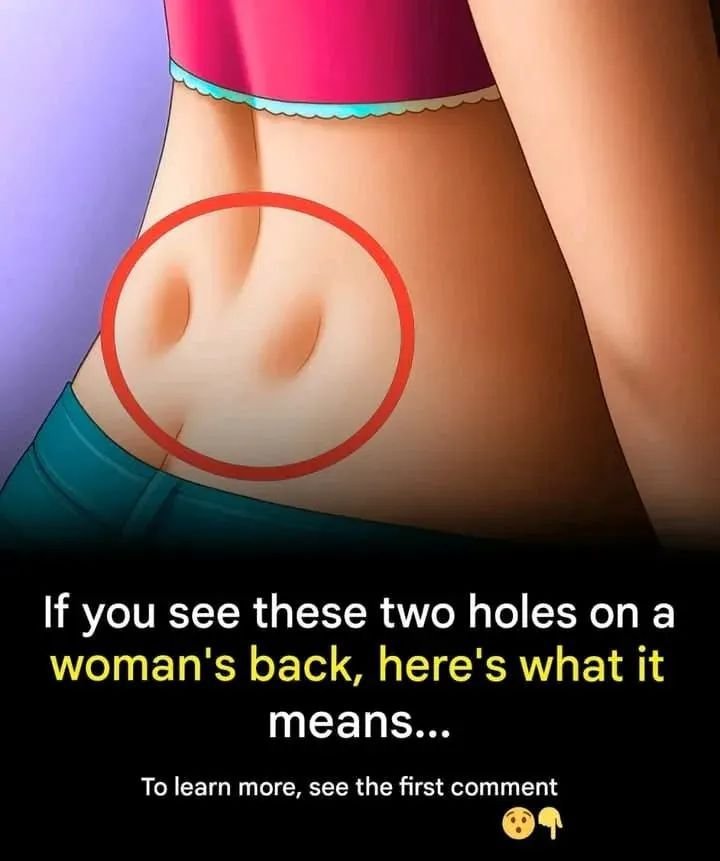
Medically referred to as fossae lumbales laterales, these are small, naturally occurring indentations located just above the sacroiliac joints, where the sacrum (bottom of the spine) meets the pelvis.
Why Do They Happen?
- Anatomy: They are caused by a short ligament that connects the skin to the posterior superior iliac spine (the upper edge of the hip bone).
- Genetics: Their presence is almost entirely determined by genetics; you are either born with them or you aren’t.
- Body Fat: While exercise cannot create these dimples (because they occur where there is no muscle), they are often more visible in individuals with a lower body fat percentage.Facebook +4
Myths vs. Facts
These dimples are frequently the subject of internet rumors and “clickbait” articles like the one in your image.
- Sexual Performance Myth: A common claim is that these dimples indicate better blood circulation in the pelvic area and make it easier for women to reach orgasm. There is no scientific evidence to support this.
- Health Indicators: Contrary to some viral posts, their presence or absence has no known medical significance regarding overall health or fertility. They are purely a cosmetic anatomical variation.
- Beauty Standards: Named after the Roman goddess of beauty, they have been historically viewed as an attractive trait and are even featured in famous classical sculptures, such as those by Michelangelo.Balkanweb.com +6
Medical Note: Symmetrical back dimples are harmless. However, if a single deep indentation (a sacral dimple) is found directly above the buttock crease in a newborn, it can sometimes be a sign of an underlying spinal condition like spina bifida.
Human anatomy is full of unique genetic variations and persistent misconceptions. Below is an overview of rare physical traits and commonly believed medical myths.
Unique Anatomical Features
These rare traits are often determined by genetics and vary significantly across the population.
Rare Physical Traits
- Golden Blood (Rhnull): The world’s rarest blood type, possessed by fewer than 50 individuals worldwide. It lacks all Rh antigens, making it universally compatible within the Rh system.
- Heterochromia: A rare condition where a person has eyes of two different colors. While it affects less than 1% of the population, it is usually a harmless genetic trait.
- Morton’s Toe: This is a foot structure where the second toe is longer than the big toe. It occurs in roughly 3–22% of people and is famously depicted in classical statues like Michelangelo’s David.
- Palmaris Longus Muscle: A remnant of human evolution, this muscle is absent in roughly 10–15% of people. You can check for it by touching your thumb to your pinky and flexing your wrist.
- Tetrachromacy: A rare genetic mutation allowing some individuals to see a much broader spectrum of colors—up to 100 million different shades—compared to the average person.
Uncommon Body Functions
- Photic Sneeze Reflex: Also known as ACHOO syndrome, this causes roughly 25% of the population to sneeze when exposed to bright sunlight.
- Gleaking: The ability to voluntarily propel a stream of saliva from the gland under the tongue. While up to 35% of people can do it accidentally, only 1% can do it on command.
Common Medical Myths Debunked
Many popular health beliefs are actually misconceptions without scientific backing.
| Myth | The Scientific Fact |
|---|---|
| We only use 10% of our brains | Brain imaging (fMRI/PET scans) shows that virtually every part of the brain is active, even during simple tasks. |
| Shaving makes hair grow back thicker | Shaving does not affect the thickness or rate of hair growth. New hair may just appear coarser because it lacks the natural taper of uncut hair. |
| You need 8 glasses of water a day | Hydration needs vary based on age, climate, and activity. Water-rich foods like fruits and other drinks also count toward your daily intake. |
| Cracking knuckles causes arthritis | The “pop” is just gas bubbles releasing in the joint fluid. Multiple studies have found no link between habitual cracking and arthritis. |
| Sugar makes kids hyperactive | Scientific studies have consistently found no link between sugar intake and behavioral changes in children. |
| Hair and nails grow after death | This is an optical illusion. After death, the skin dehydrates and retracts, making existing hair and nails appear longer. |