Why Millions Eat This Potentially Dangerous Food and How to Prepare It Safely
Why Millions Eat This Potentially Dangerous Food and How to Prepare It Safely
Imagine a food that millions of people eat regularly, a versatile ingredient that appears in countless traditional dishes and plays an essential role in food security across tropical regions. Now imagine discovering that the same food contains natural compounds capable of releasing a highly toxic substance when it is improperly prepared.
That food is cassava.
Also known as yuca, manioc, or mandioca, cassava is a starchy root vegetable consumed throughout many parts of Africa, Asia, South America, and the Caribbean. It can be boiled, mashed, fried, or transformed into flour and other traditional foods.
Yet cassava has also gained attention for a less comforting reason: its natural cyanogenic compounds.
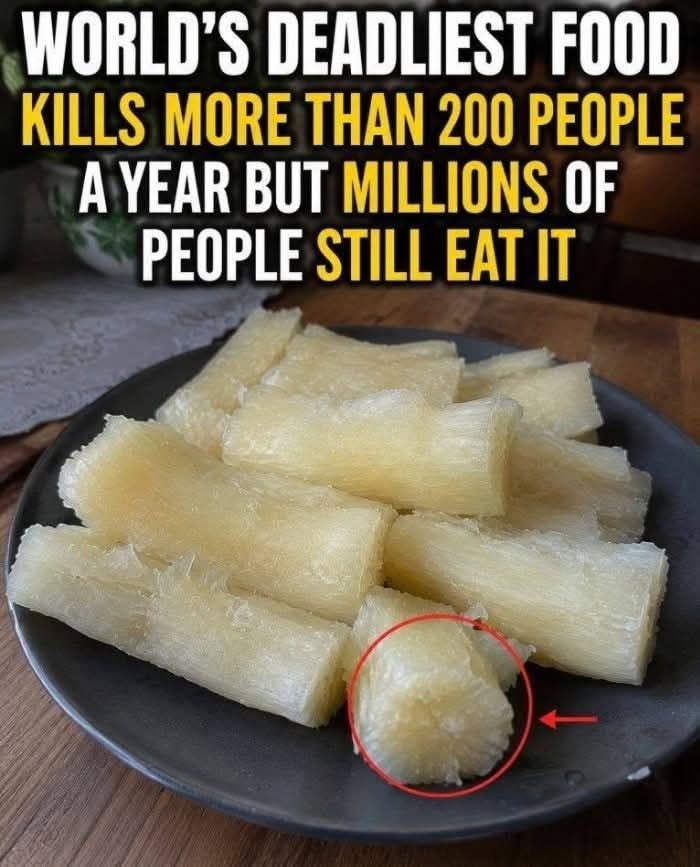
Some reports describe cassava as the world’s deadliest food and claim that improper preparation causes more than 200 deaths annually. Although serious and sometimes fatal cassava-related poisoning has been documented, that precise worldwide annual death toll is not established by the available evidence and should not be presented as a verified global statistic.
The claim that approximately 500 million people depend on cassava has appeared in historical agricultural research. The crop remains an important source of dietary energy for large populations, although the number of people consuming it varies depending on how consumption is measured.
But why does a food with potentially dangerous natural compounds remain so important?
The answer involves agriculture, nutrition, affordability, traditional knowledge, and centuries of food preparation practices.
Cassava can grow in environments where many other crops struggle. Its roots provide a valuable source of carbohydrates, and it can be processed into numerous foods that are important to local diets.
Most importantly, properly processed cassava can be consumed safely.
However, safe preparation depends on the type of cassava and the method used. Peeling and ordinary cooking may be appropriate for verified low-cyanide varieties, but high-cyanide cassava requires specialized processing. A simple soaking or boiling time cannot guarantee that every variety is safe.
Understanding that distinction is essential.
What Is Cassava?
Cassava is a tropical root crop scientifically known as Manihot esculenta. Originally domesticated in South America, it is now cultivated extensively in many warm regions of the world.
The plant produces elongated, starchy storage roots that are harvested for food.
From the outside, a cassava root may resemble a long, rough-skinned potato. Its exterior is typically brown, while the flesh inside may be white, cream-colored, or yellowish, depending on the variety.
Despite its resemblance to other root vegetables, cassava has distinct characteristics that make appropriate preparation particularly important.
It is valued for its versatility and ability to grow in challenging agricultural conditions.
In regions where rainfall is unpredictable, soil quality is poor, or access to agricultural inputs is limited, cassava can be an important food crop.
That resilience helps explain why the plant has become a staple in many communities.
Why Cassava Is Important for Food Security
Food security depends on more than simply producing enough food. Communities also need crops that can withstand local conditions, provide reliable harvests, and supply meaningful dietary energy.
Cassava contributes to those needs in several ways.
The plant is relatively tolerant of drought once established and can grow in soils that may be unsuitable for more demanding crops.
Its starchy roots provide carbohydrates, making it useful as a source of calories.
In many agricultural systems, cassava also provides flexibility because farmers can harvest roots according to local growing conditions and food requirements.
However, cassava is not a complete nutritional solution on its own.
Its roots contain relatively little protein compared with many other staple foods. A diet heavily dependent on cassava without sufficient dietary variety can contribute to nutritional deficiencies.
For this reason, cassava is best understood as an important source of energy within a varied diet rather than a complete substitute for other food groups.
Why Cassava Appears in So Many Traditional Dishes
One of cassava’s most appealing qualities is its versatility.
Depending on the variety and processing method, cassava can be transformed into foods with very different textures and flavors.
Properly prepared roots may be boiled until tender, mashed, or incorporated into savory dishes.
Other preparations involve grating, fermenting, pressing, drying, roasting, or milling the roots.
These techniques are especially important in communities where cassava has been prepared for generations.
They are not simply culinary traditions.
Many also serve a critical food-safety purpose by reducing naturally occurring cyanogenic compounds.
Why Can Cassava Be Dangerous?
The potential danger associated with cassava comes from compounds known as cyanogenic glycosides.
These substances occur naturally in the plant.
Two important examples are linamarin and lotaustralin.
When cassava tissue is damaged, enzymes can interact with these compounds, initiating reactions that may release hydrogen cyanide.
Hydrogen cyanide is toxic because it can interfere with the body’s ability to use oxygen at the cellular level.
This makes improperly processed cassava potentially dangerous, particularly when roots or products containing high cyanogenic levels are consumed.
The amount of cyanogenic material varies considerably among cassava varieties and can also be influenced by growing conditions and other factors.
Not every root presents the same level of risk.
Nevertheless, raw cassava should not be treated as an ordinary ready-to-eat vegetable.
What Happens When Cassava Is Eaten Raw?
Raw cassava contains compounds that can release cyanide during preparation and digestion.
Eating raw or inadequately processed cassava can expose a person to these substances.
The risk depends on how much is consumed, the cyanogenic content of the particular cassava, and the effectiveness of any processing it has undergone.
Because these factors are not obvious from appearance alone, tasting raw cassava to determine whether it is safe is not a reliable approach.
Proper identification and preparation are much safer than experimentation.
What Is Cyanide Poisoning?
Cyanide poisoning occurs when exposure interferes with essential cellular processes.
Serious cases can become medical emergencies.
Possible symptoms include headache, dizziness, nausea, vomiting, weakness, confusion, and breathing difficulties.
Severe exposure can lead to seizures, loss of consciousness, cardiovascular collapse, and death.
Symptoms may develop rapidly after significant exposure.
If cyanide poisoning is suspected following consumption of cassava or another potentially toxic food, seek emergency medical attention immediately.
Do not wait for symptoms to become severe or attempt to manage suspected poisoning with home remedies.
Can Cassava Cause Problems Beyond Acute Poisoning?
Yes. In some settings, prolonged dietary exposure to inadequately processed cassava has been associated with chronic neurological problems.
One important example is konzo, a neurological condition associated with high dietary exposure to cyanogenic compounds in populations whose diets are heavily dependent on insufficiently processed cassava and low in certain essential nutrients.
Konzo can cause sudden, lasting difficulties with movement, particularly affecting the legs.
The condition illustrates why proper cassava processing and adequate overall nutrition are both important public-health considerations.
Sweet Cassava and Bitter Cassava: Understanding the Difference
Cassava is commonly discussed in two broad categories: sweet cassava and bitter cassava.
The distinction relates to differences in cyanogenic content, although the terminology is not a perfect safety test.
Sweet Cassava
Sweet cassava generally contains lower concentrations of cyanogenic compounds than bitter varieties.
It is commonly sold for direct household cooking in markets where cassava is consumed as a root vegetable.
When the variety is verified as suitable for direct cooking, peeling it thoroughly and cooking it properly can reduce the risk.
However, sweet cassava is not automatically safe to eat raw.
It still requires appropriate preparation.
Consumers should purchase cassava from a reliable supplier and follow the preparation guidance for the product they have.
Bitter Cassava
Bitter cassava generally contains higher levels of cyanogenic compounds.
Because of that, it requires more extensive processing before consumption.
Traditional methods may involve combinations of grating, prolonged soaking, fermentation, pressing, washing, and appropriate drying or roasting.
These processes are designed to break down and remove cyanogenic compounds more effectively than ordinary cooking alone.
High-cyanide cassava should not be prepared using a simple household boiling method intended for low-cyanide roots.
Its processing requires a validated method appropriate to the particular product.
Can You Identify the Variety by Taste or Appearance?
It is not safe to rely on taste, color, or appearance alone to establish whether an unknown cassava root is suitable for simple cooking.
Although the names sweet and bitter suggest a flavor difference, cyanogenic content cannot be measured reliably by tasting.
Different varieties may also look very similar.
If the variety is uncertain, the safest choice is to obtain identification and preparation guidance from a knowledgeable supplier or agricultural food-safety authority.
Do not assume that an unidentified root becomes safe after an arbitrary number of hours of soaking or boiling.
How Proper Processing Makes Cassava Safer
Traditional cassava preparation often combines several techniques because no single method works equally well for every variety.
The effectiveness of processing depends on factors such as cyanogenic concentration, the size of the pieces, how thoroughly the plant tissue is broken down, the duration and conditions of fermentation, and the final cooking or drying method.
Understanding the purpose of each technique helps explain why traditional processing methods can be so important.
- Peeling
Peeling removes the outer covering and layers beneath it that can contain substantial concentrations of cyanogenic compounds.
It also removes dirt and surface material from the harvested root.
This is an important preparation step, but it does not eliminate every potential source of cyanogenic compounds in the root.
Peeling alone is not sufficient for high-cyanide cassava.
- Cutting, Grating, or Crushing
Breaking cassava into smaller pieces increases its exposed surface area.
Grating and crushing can also disrupt the internal structure of the plant tissue.
This helps bring naturally occurring enzymes into contact with cyanogenic compounds, promoting reactions that are important during detoxification.
For high-cyanide varieties, the extent of tissue disruption can be critical to the effectiveness of subsequent processing.
Simply cutting a root into large chunks does not provide the same effect as thoroughly grating or crushing it.
- Soaking
Soaking allows some water-soluble compounds to move out of the cassava.
Extended soaking may also contribute to fermentation, depending on the method and conditions.
However, a short soaking period does not guarantee that sufficient cyanogenic compounds have been removed.
The original source suggests soaking for 24–48 hours, but that period must not be treated as universally safe, particularly for bitter or unidentified cassava.
Published food-safety guidance describes processing methods that may require substantially longer periods and additional steps.
Soaking should therefore be understood as one possible component of a validated process, not a universal shortcut.
- Fermentation
Fermentation plays a major role in numerous traditional cassava products.
During appropriate fermentation, biochemical changes help break down cyanogenic compounds.
When combined with grating, pressing, washing, and other suitable processing steps, fermentation can substantially reduce cyanogenic potential.
Its effectiveness depends on the complete method and the conditions under which it is performed.
An incomplete or poorly controlled process may leave unsafe concentrations behind.
- Pressing and Washing
For certain grated cassava products, pressing removes liquid from the processed material.
Washing can help remove water-soluble substances released during processing.
These steps are frequently combined with fermentation or other traditional techniques.
The purpose is not merely to change texture.
They contribute to the removal of potentially harmful compounds.
- Drying and Roasting
Appropriate drying and roasting techniques can further reduce cyanogenic compounds in processed cassava.
However, simply leaving raw cassava pieces to dry for a short period is not a reliable way to ensure safety.
The effectiveness of drying depends on the preparation method, duration, conditions, and whether other detoxification steps have occurred first.
Traditional cassava products often use carefully established combinations of processing methods rather than relying on drying alone.
How to Prepare Low-Cyanide Cassava Safely at Home
For home cooks, the most important starting point is knowing what type of cassava they have purchased.
The following general guidance is intended for verified low-cyanide cassava sold for direct household cooking.
It is not a detoxification procedure for bitter or high-cyanide varieties.
Step 1: Purchase Cassava From a Reliable Supplier
Choose cassava sold specifically for food use by a reputable vendor.
When possible, confirm that the product is a low-cyanide variety suitable for direct cooking.
If the supplier cannot identify the variety or explain its preparation requirements, do not assume that ordinary boiling will make it safe.
For unfamiliar cassava products, follow authoritative local preparation instructions.
Step 2: Peel the Root Thoroughly
Remove the tough outer brown skin and the underlying peel layer.
Work carefully so the edible portion is properly exposed.
Peeling is an essential step for cassava intended for direct cooking.
It helps remove portions of the root that may contain higher levels of cyanogenic compounds.
However, the interior can still contain these substances, so additional preparation is necessary.
Step 3: Follow the Appropriate Preparation Method
For verified low-cyanide cassava, follow the supplier’s established instructions for cutting and preparing the root.
Some preparations involve soaking before cooking, but the required method depends on the variety and intended dish.
Do not assume that soaking for 24–48 hours is sufficient for every cassava root.
For high-cyanide cassava, specialized processing is necessary and should follow validated local practices or established food-safety guidance.
Step 4: Cook Thoroughly
Low-cyanide cassava intended for direct cooking should be fully cooked using the recommended method.
Boiling is one common preparation technique.
When soaking or boiling water is used as part of cassava preparation, it should be discarded rather than reused for soups, sauces, or drinks.
Cooking time can vary according to root size and preparation method.
Most importantly, do not rely on a fixed 20–30-minute boiling period to detoxify unidentified or high-cyanide cassava.
Thorough cooking can be part of safe preparation for appropriate low-cyanide varieties, but ordinary boiling alone is not a reliable detoxification method for high-cyanide roots.
Step 5: Serve Only When Proper Preparation Is Confirmed
Once the cassava has been prepared according to a suitable method, it can be incorporated into a meal.
For verified low-cyanide varieties, the cooked root is commonly used in savory dishes or mashed preparations.
For processed cassava products, follow the manufacturer’s directions and local food-safety recommendations.
If you are uncertain whether the cassava was adequately processed, do not use tasting or appearance as a safety check.
When the preparation history is unknown, it is safer not to consume the product.
Traditional Cassava Processing Methods
Across different regions, communities have developed methods of preparing cassava that reflect local food traditions, available equipment, and knowledge accumulated over generations.
Many of these methods are especially valuable because they combine several processes that reduce cyanogenic compounds.
The techniques may differ between communities and products, but their shared purpose is to transform cassava into food that can be consumed safely.
Fermented Cassava Products
Some traditional cassava foods begin with grated or crushed roots that undergo fermentation.
This process may be followed by pressing, washing, drying, or heating, depending on the product.
The combination can be much more effective at reducing cyanogenic compounds than a single brief cooking step.
Fermentation also contributes to the characteristic flavors and textures of certain regional preparations.
However, successful detoxification depends on following an appropriate established method.
Cassava Flour
Cassava can be processed into flour used in numerous traditional dishes.
Properly produced food-grade cassava flour undergoes processing intended to meet relevant safety requirements.
Commercially processed products from reputable suppliers are generally more appropriate for inexperienced home cooks than attempting to detoxify high-cyanide roots without proper knowledge.
Not every homemade flour preparation is automatically safe.
Insufficient processing can leave harmful cyanogenic compounds in the finished product.
Boiled Cassava
Boiled cassava is popular in many places where verified low-cyanide varieties are used for direct cooking.
When properly prepared, the root develops a soft, starchy texture that works well with a variety of meals.
However, this method must not be confused with the more extensive processing required for bitter cassava.
The suitability of direct boiling depends on the type of root.
Why Traditional Knowledge Matters
Traditional food preparation methods are sometimes described only in terms of flavor or cultural identity.
In the case of cassava, they can also represent important safety knowledge.
Grating, fermenting, pressing, and drying may appear labor-intensive compared with simply boiling a vegetable.
But these practices can serve essential purposes.
They help transform a potentially hazardous raw material into foods that can be consumed with substantially reduced risk.
Respecting validated traditional methods is therefore an important part of understanding cassava as a food crop.
Why Improperly Processed Cassava Still Causes Poisoning
If safe processing methods are known, why do cassava-related poisoning incidents still occur?
The answer is complex.
Food safety depends on more than knowledge alone.
Access to suitable equipment, water, time, and reliable food supplies can all affect preparation practices.
Food Insecurity and Emergency Conditions
When communities experience food shortages, households may have fewer options and may be forced to rely heavily on available crops.
In some situations, insufficient food supplies or pressure to prepare meals quickly can lead to shortened processing times.
That can increase the risk of exposure when high-cyanide cassava is consumed.
Food insecurity can also contribute to less varied diets, increasing the health risks associated with prolonged exposure.
Drought and Changes in Crop Conditions
Environmental conditions can influence the cyanogenic content of cassava.
Periods of drought and other stresses may affect the concentration of natural plant compounds.
This means that familiar-looking roots cannot always be assumed to have the same composition under every growing condition.
Reliable processing remains important even when cassava is grown and consumed routinely.
Incomplete Processing
Another risk arises when traditional processing steps are shortened, omitted, or performed incorrectly.
For example, insufficient fermentation or drying may leave more cyanogenic compounds in the final product than expected.
Similarly, boiling raw high-cyanide cassava without appropriate prior processing may fail to reduce the hazard sufficiently.
This is why authorities emphasize complete processing procedures rather than relying on a single preparation step.
Unreliable Identification
People unfamiliar with cassava may not know whether a root is suitable for ordinary cooking.
Because appearance and taste are not dependable safety measures, unfamiliar products can present additional uncertainty.
Clear labeling, reliable suppliers, and local preparation guidance help reduce this risk.
Documented Cassava Poisoning Outbreaks
Cassava-related poisoning is not simply a theoretical concern.
Public-health authorities have documented outbreaks involving inadequately processed cassava products.
For example, the United States Centers for Disease Control and Prevention reported a cyanide-poisoning outbreak in Uganda in 2017 linked to cassava flour.
The investigation highlighted the dangers of consuming products containing elevated cyanogenic compounds when processing is insufficient.
Such incidents demonstrate why the preparation method matters and why food-safety guidance should not oversimplify the risks.
They also show why public-health education, product monitoring, and access to reliable processing techniques are valuable.
Is Cassava Nutritious?
Cassava is primarily valued as a source of carbohydrates.
Its roots provide dietary energy, which helps explain the crop’s importance in areas where food security is a major concern.
However, cassava should not be described as a complete nutritional food on its own.
Carbohydrates and Energy
The edible cassava root contains substantial amounts of starch.
That makes it a useful energy source within many traditional diets.
For populations that rely on locally grown staple crops, its contribution to calorie intake can be especially important.
Protein and Nutritional Balance
Cassava roots are relatively low in protein.
A diet based almost entirely on cassava may therefore provide insufficient amounts of certain nutrients unless it is complemented by other foods.
This matters particularly in communities where cassava is consumed in large quantities because of limited food availability.
Dietary variety helps improve nutritional balance.
Other Nutritional Components
Cassava can contribute certain vitamins and minerals, although amounts vary according to variety, growing conditions, and preparation.
Some processing methods can also reduce water-soluble nutrients.
The nutritional value of a cassava dish therefore depends on more than the raw root itself.
Preparation and the other foods included in the meal also matter.
Frequently Asked Questions About Cassava
Is Cassava Really the World’s Deadliest Food?
There is no universally accepted scientific ranking that identifies cassava as the world’s single deadliest food.
The phrase is a dramatic headline used to draw attention to its cyanide-related risks.
Improperly processed cassava can cause serious poisoning, but properly processed cassava is widely consumed.
Does Cassava Really Cause More Than 200 Deaths Every Year?
The figure appears in some popular accounts, but a reliable, consistently verified worldwide annual death toll of more than 200 people has not been established by the information available here.
Documented poisoning outbreaks confirm that the danger is real, but they do not establish that particular global statistic.
Can You Eat Cassava Raw?
No. Raw cassava should not be eaten because it contains cyanogenic compounds that can release toxic cyanide.
Appropriate processing is necessary before consumption.
Is Sweet Cassava Safe?
Verified low-cyanide cassava sold for direct household cooking can generally be prepared by thorough peeling and appropriate cooking.
However, sweet cassava should not be eaten raw, and unidentified varieties should not be assumed safe.
Is Bitter Cassava More Dangerous?
Bitter cassava generally contains higher levels of cyanogenic compounds and requires more extensive processing.
Simple boiling is not a dependable way to detoxify high-cyanide roots.
Does Boiling Remove All the Cyanide?
Not necessarily.
Boiling can reduce cyanogenic content, but it does not reliably eliminate the hazard from all cassava varieties.
High-cyanide cassava often requires additional processing before cooking.
Is Soaking Cassava for 24–48 Hours Enough?
Not as a universal rule.
The necessary method depends on the cassava variety and the complete processing procedure.
Some validated traditional methods involve longer soaking or fermentation along with other steps.
Can Cassava Flour Contain Cyanide?
Yes. Inadequately processed cassava flour can retain cyanogenic compounds.
Choose food-grade products from reliable suppliers and follow their preparation instructions.
Can Children Eat Cassava?
Children may eat properly processed cassava as part of an age-appropriate, nutritionally varied diet.
Because children are more vulnerable to some food-related exposures due to their smaller body size, safe preparation is particularly important.
What Should You Do if Someone Develops Symptoms After Eating Cassava?
Seek emergency medical attention immediately if cyanide poisoning is suspected.
Symptoms such as severe dizziness, confusion, breathing difficulties, seizures, or loss of consciousness require urgent care.
Do not attempt to treat suspected poisoning at home.
Practical Cassava Safety Tips for Everyday Cooking
Understanding cassava safety does not mean avoiding every cassava-based food.
Instead, it means recognizing that different products require different handling methods.
For everyday home cooking, several precautions are especially important.
Choose Reliable Sources
Purchase cassava and cassava products from suppliers that can identify the product and provide appropriate preparation instructions.
Avoid using unknown roots when the variety and required processing method cannot be established.
Do Not Skip Essential Processing Steps
When a product requires fermentation, grating, washing, pressing, drying, or another preparation method, do not shorten the process without reliable evidence that doing so is safe.
Traditional processing stages often serve specific detoxification purposes.
Never Use Raw Cassava as a Taste Test
Tasting an unfamiliar root is not a safe way to determine its cyanogenic content.
The absence of an obviously bitter taste does not prove that a product is safe to eat raw.
Do Not Rely on Cooking Time Alone
A root becoming soft does not establish that all hazardous cyanogenic compounds have been adequately reduced.
Cooking instructions must be appropriate for the type of cassava being prepared.
Pay Attention to Processed Products
Flour, dried chips, and other cassava products should come from reliable sources and be processed according to relevant food-safety standards.
Products that have been prepared inadequately may retain dangerous compounds even when they appear dry or ready for cooking.
Encourage Safe Food Preparation Practices
In communities where cassava is a major staple, clear food-safety information can help reduce preventable illness.
Preserving knowledge about validated processing methods is particularly important when food shortages or time pressures make shortcuts tempting.
Why Cassava Remains an Essential Crop
Despite its natural hazards, cassava continues to play a major role in food systems around the world.
It is a crop with valuable agricultural characteristics, and it supports many traditional diets and food-processing industries.
Its resilience in difficult growing conditions makes it especially relevant to discussions about food security.
But cassava’s importance should never be used to minimize the consequences of improper preparation.
The history of cassava consumption demonstrates two important truths.
First, the plant can be an essential and valuable food source.
Second, the knowledge required to process it safely deserves respect.
Traditional methods developed over generations often reflect a detailed understanding of how to transform the root into suitable food.
Modern food-safety research has helped explain why many of those methods work and why incomplete processing can be dangerous.
Together, agricultural knowledge and scientific evidence offer a more accurate picture than sensational headlines alone.
Final Thoughts: Cassava Is Valuable, but Safe Preparation Matters
Cassava is one of the world’s most important tropical root crops.
Its versatility, adaptability, and carbohydrate content help explain why it remains central to so many traditional diets.
But unlike ordinary root vegetables that require cooking primarily for texture and flavor, cassava contains natural cyanogenic compounds that make appropriate preparation essential.
The risks vary between varieties.
Verified low-cyanide cassava may be suitable for direct cooking after thorough peeling and proper preparation.
High-cyanide cassava requires more extensive processing, often involving several techniques designed to reduce its cyanogenic content.
Peeling, grating, soaking, fermentation, pressing, drying, and cooking can each play a role, but their effectiveness depends on how they are combined.
There is no single short soaking period or boiling time that guarantees every type of cassava is safe.
For home cooks, the most practical approach is to choose cassava from a reliable supplier, identify the variety, and follow appropriate preparation instructions.
For communities that depend heavily on cassava, protecting traditional processing knowledge and supporting food-safety education can help prevent serious illness.
The most important lesson is that cassava should be neither feared indiscriminately nor treated casually.
It is a valuable food with genuine hazards that can be managed through appropriate, validated processing.
And understanding the difference is what allows this remarkable crop to remain an important part of diets around the world.
Food-safety note: The original article’s suggested 24–48-hour soak and 20–30-minute boil should not be treated as a universally safe preparation method. Research and food-safety guidance show that high-cyanide cassava can require substantially more extensive processing, and boiling alone may be insufficient. This expanded article corrects that potentially dangerous oversimplification.